Peter Franck
CTO
Vienna/Hamburg - 30. 5 2026 - DI (FH) Markus Häfele
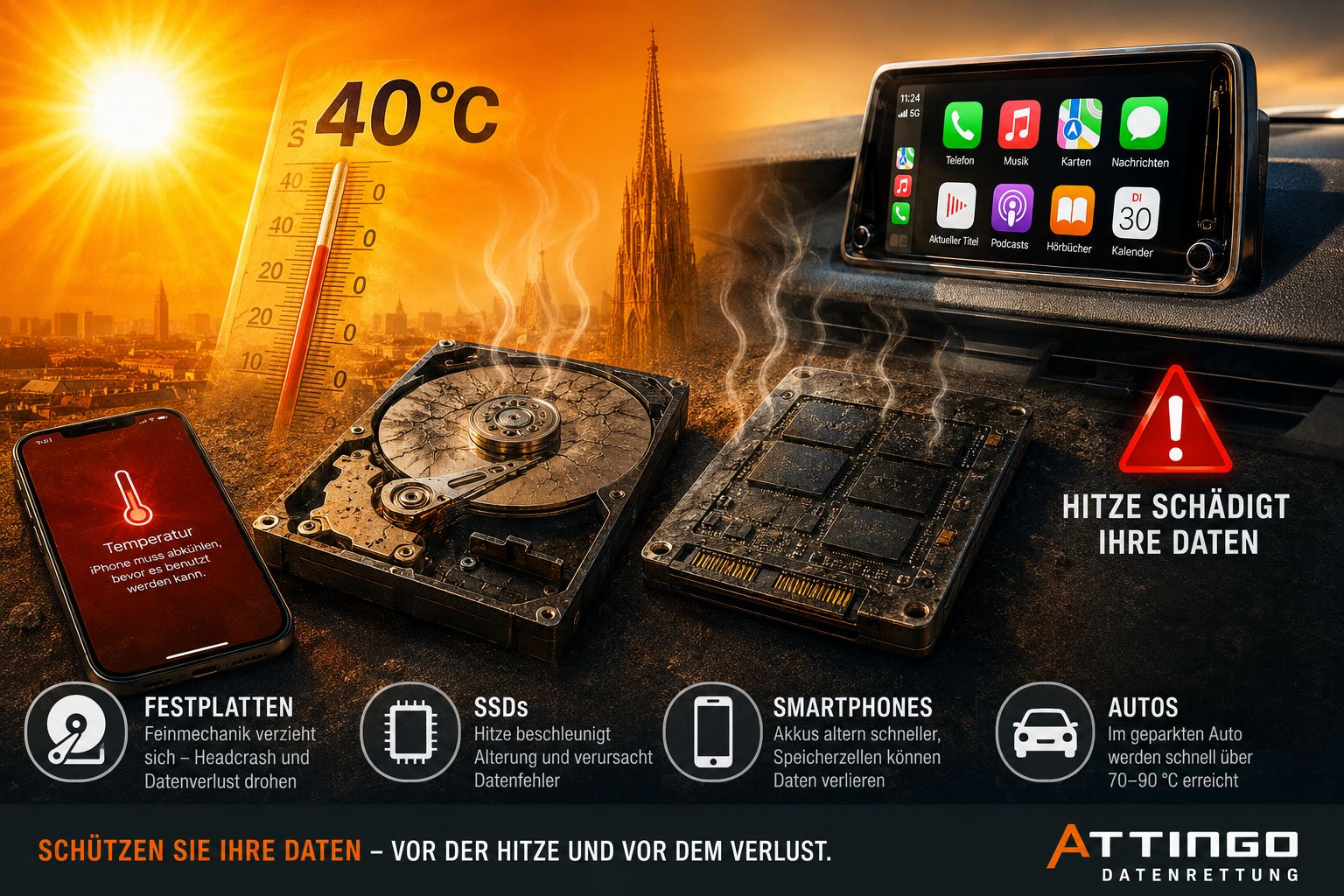
Austria and Germany are currently experiencing an extraordinary heatwave: on June 28, 2026, Vienna's Inner City recorded exactly 40.0 degrees Celsius, breaking the 40-degree mark for the first time in the capital's 250-year weather history. The following day, Bad Deutsch-Altenburg reached 40.1 degrees – a new all-time Austrian June record. According to Germany's national weather service (DWD), Neißemünde likely set a new record on June 28 with 41.7 degrees. What is already a strain for people often marks the beginning of the end for technical devices and their storage media: hard drives, SSDs, NAS systems and smartphones respond to extreme heat with elevated failure rates – risking the loss of irreplaceable data.
"On hot summer days, data recovery specialists are called in up to twice as often," explains Markus Häfele, Managing Director of Attingo Datenrettung. "The current record temperatures are dramatically amplifying this effect. What many people don't realize: the permissible operating temperature of most devices is already reached at 35 degrees Celsius – a threshold we have now clearly exceeded."
The inner workings of a magnetic hard disk drive (HDD) operate within a physical tolerance range that leaves almost no room for thermal influence. During normal operation, the read/write heads glide just a few nanometers above the spinning magnetic platters – without ever touching them. Even minimal thermal expansion of the metal components can alter this gap and trigger the dreaded head crash: the heads strike the magnetic surface, irreversibly destroying the data layer and leaving behind microscopic "scratches."
There is also an often-underestimated secondary risk: devices that still function under heat exposure can fail after cooling down, because the expanded material does not return precisely to its original position as it cools. Read/write heads that were correctly positioned while hot can end up permanently misaligned once cooled – the drive is then no longer recognized, or returns nothing but read errors.
"In these cases, our technicians can recover the data through highly precise adjustment of the read/write heads under a microscope in our cleanroom," explains Peter Franck, Technical Director at Attingo. "What's critical is that affected devices are powered off immediately – any further operation after heat damage increases the mechanical damage and makes later recovery more difficult."
The manufacturer-specified maximum temperatures are often little known: many external USB hard drives are rated for a maximum ambient operating temperature of 35 degrees Celsius – a threshold easily exceeded in non-air-conditioned offices or in a parked car on hot days like the current ones.
Solid-state drives and flash storage in smartphones, tablets and USB sticks have no moving parts – leading to the common misconception that they are more heat-resistant than HDDs. In reality, NAND flash cells respond to elevated temperatures with altered charge distribution: under sustained heat, already-stored bits can "drift" – meaning the charge held in the floating-gate transistors changes thermally, which can cause silent read errors that users often don't notice until weeks or months later.
In addition, write error rates increase at higher temperatures: error correction code (ECC) algorithms in the flash controller can correct many of these errors, but above the rated operating temperature, the error rate rises disproportionately and eventually exceeds the correction capacity. The result can be corrupted files or, in particularly unfavorable cases, a total failure of the flash controller.
The situation is especially critical for modern 3D NAND storage: the stacked cell layers significantly increase heat density within the chip. Under load combined with high ambient temperatures, conditions can arise that significantly shorten cell lifespan relative to manufacturer specifications.
One of the most common causes of summer damage is carelessly leaving devices in a parked vehicle. As a rule of thumb, in direct sunlight the interior temperature of a car rises by roughly one degree per minute. At current outside temperatures of 38 to 40 degrees – as recorded in Vienna and Lower Austria over the past few days – interior temperatures of 70 degrees and higher are possible, with dashboard surfaces in direct sunlight reaching significantly higher still.
An internal infrared test conducted by Attingo measured dashboard temperatures of up to 90 degrees Celsius at midday. Hard drives and SSDs exposed to such conditions, even briefly, can suffer permanent damage – even while powered off.
Smartphones face two additional damage mechanisms: lithium-ion batteries age irreversibly faster above 45 degrees Celsius; above roughly 60 degrees, chemical processes can begin that, in worst cases, lead to so-called thermal runaway – an uncontrolled chain reaction that can cause swelling, gas release, or in extreme cases, a battery fire. At the same time, the NAND flash chips used for smartphone storage are exposed to the same thermal stress as standalone SSDs, with the key difference that users receive no status information whatsoever about the condition of that storage.
Non-air-conditioned office and server rooms are the rule rather than the exception, particularly among small and medium-sized enterprises (SMEs). While a single drive failure within a RAID array is typically tolerable – that's exactly what the redundancy is designed for – heat-induced simultaneous degradation of multiple drives can cause an entire RAID group to collapse without adequate warning from the system. The combination of elevated ambient temperature, aging drive inventory, and insufficient monitoring is a classic scenario during the data recovery industry's busiest season.
"In summer, we also see a sharp rise in our high-priority cases, where we work around the clock on extremely urgent data recovery jobs," explains Markus Häfele. "Many companies don't realize how quickly high temperatures can bring their IT infrastructure to a standstill. The result is often a full operational shutdown – but we can frequently reduce that downtime to just a few hours."
First and foremost: immediately power off and disconnect any suspect device. Continued operation after heat damage increases mechanical damage in HDDs and, in SSDs and flash storage, can cause damaged areas to be overwritten. Under no circumstances should affected devices be cooled in a refrigerator or freezer – the resulting condensation causes secondary damage through short circuits, which can significantly complicate or even prevent data recovery.
Attingo Datenrettung offers a 24/7 high-priority service and successfully recovers data in over 98% of cases – even after severe heat damage.
For private users:
For businesses:
Attingo Datenrettung has been Austria's specialist in professional data recovery since 1997. The company operates fully equipped, technologically advanced cleanroom labs in Vienna, Hamburg and Amsterdam, and maintains its own parts inventory of over 14,500 hard drives and SSDs. Attingo runs its own research and development department and follows established, quality-assured processes. Data recovery is offered on a "no data, no charge" basis. More than 98% of all cases result in successful data recovery.
Media contact:
Attingo Datenrettung GmbH
Perfektastraße 55/2, 1230 Vienna, Austria, Tel.: +43 1 2360101, Email: info@attingo.at
Warnstedtstrasse 12b, 22525 Hamburg, Germany, Tel.: +49 40 54887560, Email: info@attingo.de
Web: www.attingo.at | www.attingo.de | www.attingo.com
Note to editors: Markus Häfele (Managing Director) and Attingo's technical experts are available for interviews and quotes on short notice.